

 [[{“value”:”
Loosey-goosey financial conditions don’t mean low borrowing costs. They just mean narrow yield spreads.
By Wolf Richter for WOLF STREET.
Measures of “financial conditions” and “financial stress” have loosened dramatically since 2023 and are now nearly as loosey-goosey as they had been during the reckless monetary policy era in 2021, when the Fed’s policy rates were at near 0% and QE still ruled, despite surging inflation.
These measures, such as the Chicago Fed’s National Financial Conditions Index (NFCI) and the St. Louis Fed Financial Stress Index, are in part driven by a basket of “yield spreads,” and yield spreads have narrowed sharply and are very tight, near record tight.
But just because “financial conditions” are near-record loose as yield spreads have narrowed in a mindboggling manner doesn’t mean that corporate borrowing cost are as low as they were in 2021. Far from it.
Corporate borrowing costs – including Commercial Real Estate – are much higher than they had been in 2021. It’s just that credit-market mania has crushed risk premiums, to where investors are demanding only a little extra compensation in form of yield to take on a lot more credit risks.
Here, we’ll look at the junk-rated (higher risk) corporate credit spectrum: leveraged loans and junk bonds.
Leveraged loans are mostly floating-rate loans that trade like junk bonds, or are securitized into collateralized loan obligations (CLOs). The floating rate is now based on the Secured Overnight Financing Rate (SOFR), which has replaced LIBOR. SOFR is based on transactions in the Treasury repo market, where yields are close to the Fed’s policy rates.
Most leveraged loans are priced at SOFR plus some percentage points, for example, SOFR plus 3.75 percentage points, such as Cornerstone Generation’s newly issued loan package which S&P rated ‘BB-‘ (our cheat sheet for corporate credit ratings by rating agency).
SOFR on Friday was 4.60%, according to the New York Fed, which calculates and publishes SOFR. That’s right in the middle of the Fed’s five policy rates since the November rate cut, ranging from 4.50% to 4.75%. SOFR plus 3.75% would be 8.35%, compared to about 3.80% in 2021.
When rates get cut – and if they get cut by as much as there borrowers and Wall Street are dreaming about – the interest costs of all existing floating-rate loans are going to drop (which is very different from junk bonds, as we’ll see in a moment). But at the moment, leveraged-loan rates remain high:
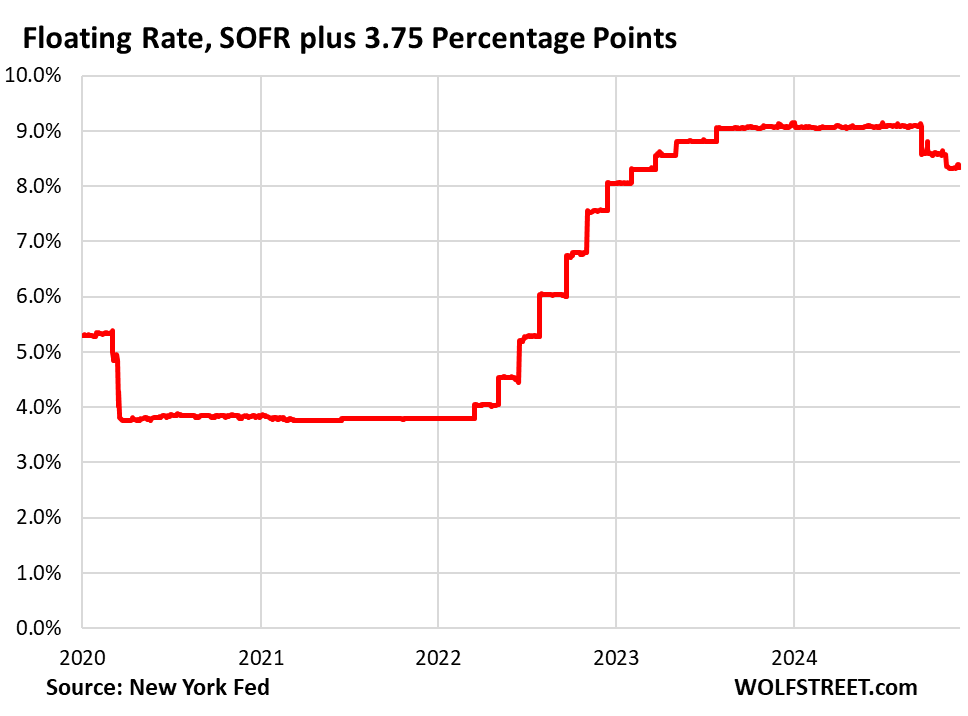
Where the “yield spread” comes in is the percentage over SOFR. If financial conditions weren’t as loosey-goosey, the Cornerstone Generation loan package might have been priced at SOFR plus 4.5 percentage points to find investors. But now investors are chasing yield, creating huge demand for higher-risk corporate credits, thereby narrowing the spread between leveraged-loan rates and SOFR.
These ultra-loose financial conditions – allowing Cornerstone to issue leveraged loans rated ‘BB-‘ at a spread of only 3.75 percentage points over a near-risk-free short-term rate – are the reason there has been a massive surge in leveraged-loan issuance in recent months.
Floating rate CRE loans are priced the same way, SOFR-plus, which is why CRE mortgages with floating rates were the first to default because the properties didn’t generate enough cash from rent payments to pay the interest payments that had more than doubled (though landlords could hedge against some of that risk, and many did, but not enough).
SOFR-based floating rates have come down by only about 75 basis points from the peak after the Fed’s 75-basis-points in rate cuts, and remain very high. And now companies with this kind of debt, and landlords with floating-rate mortgages are praying for massive rate cuts by the Fed, which would directly reduce the interest costs of existing floating rate leveraged loans and CRE mortgages.
Junk bonds are usually fixed-rate debt. Once borrowers issue the bonds, their interest payments don’t change through maturity of the bond, regardless of what the Fed does or where long-term bond yields go. Issuers have to live with that rate.
At the upper end of the junk bond spectrum, the yield of BB-rated corporate bonds (our cheat sheet for corporate credit ratings) was on average 5.71% at Friday’s close, according to the ICE BofA BB US High Yield Index, up by about 2.7 percentage points from the low in 2021.
So the BB-rated yield has nearly doubled from the low of 2021, but is way down from the top of the spike in October last year, of around 8%.
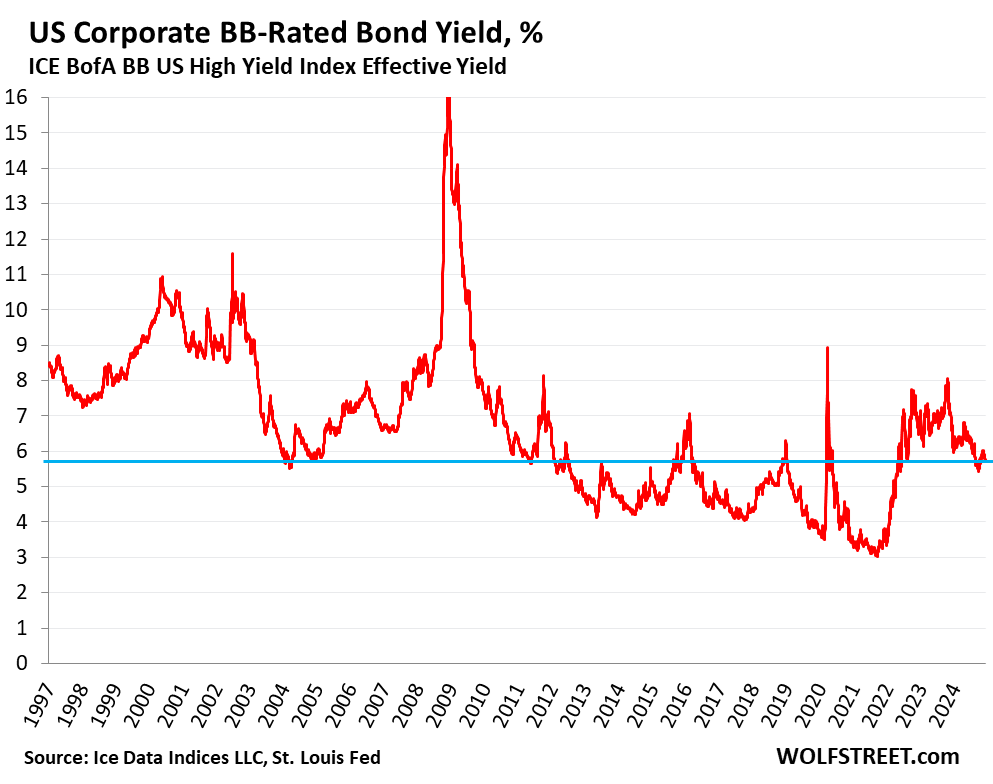
Junk-bond yields have dropped since October last year, for two reasons: because the long-term Treasury yields have dropped from the peak in October last year; and because the yield spread from junk debt to Treasury debt as narrowed sharply and is now near record lows.
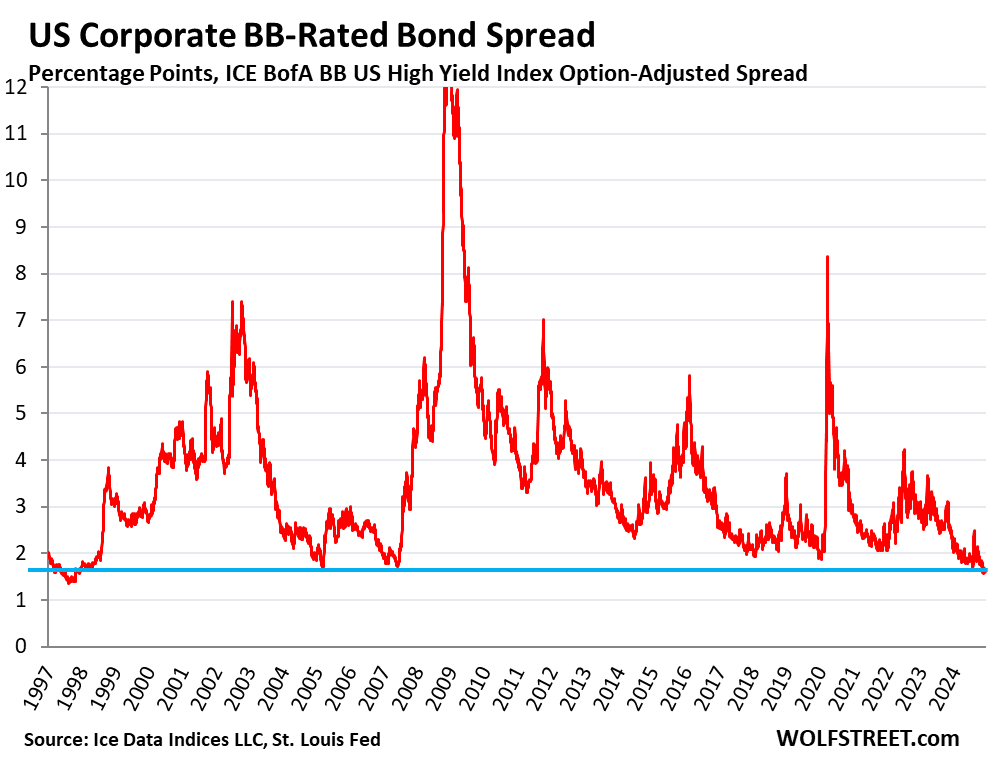
For example, the yield spread of BB-rated junk bonds to Treasury debt with equivalent maturity dropped as low as 1.57 percentage points in November – the narrowest since the late 1990s. On Friday, the yield spread was 1.62 percentage points, according to the ICE BofA BB US High Yield Index Option-Adjusted Spread Index.
Junk bonds have also seen a surge in issuance in recent months amid ravenous demand from investors, and this ravenous demand from investors chasing a little extra yield for a lot more risk is what caused spreads to narrow, and financial conditions to loosen.
These spreads are the signs of a credit-market mania – even though interest rates and yields are still higher, and in terms of floating rate debt, high.
Enjoy reading WOLF STREET and want to support it? You can donate. I appreciate it immensely. Click on the beer and iced-tea mug to find out how:

Would you like to be notified via email when WOLF STREET publishes a new article? Sign up here.

The post Credit-Market Mania Crushed “Yield Spreads” & Risk Premiums, but Corporate & CRE Borrowing Costs Are Still Much Higher appeared first on Energy News Beat.
“}]]